Guide
Dehumidifier laundry mode explained
Published
Note: This page contains affiliate links. If you buy through them we may earn a commission at no extra cost to you. Learn more
In short
Laundry mode tells a dehumidifier to dry clothes rather than hold a room at a set humidity. On most machines it runs extraction continuously, sets the fan to high, opens or swings the louvre and often stops after a fixed number of hours. To get the most from it, use a small room with the door shut, space the clothes out, and point the airflow at the airer from about a metre away.
Products for this job
Compare all 8 products20 L/day
Meaco Arete Two 20L: 6 hour laundry mode
Check price on AmazonAffiliate link21 L/day
Ariston Deos 21S NET: Super Laundry function
Check price on AmazonAffiliate link10 L/day
EcoAir DD3 Slimline: laundry mode and swinging louvre
Check price on AmazonAffiliate link
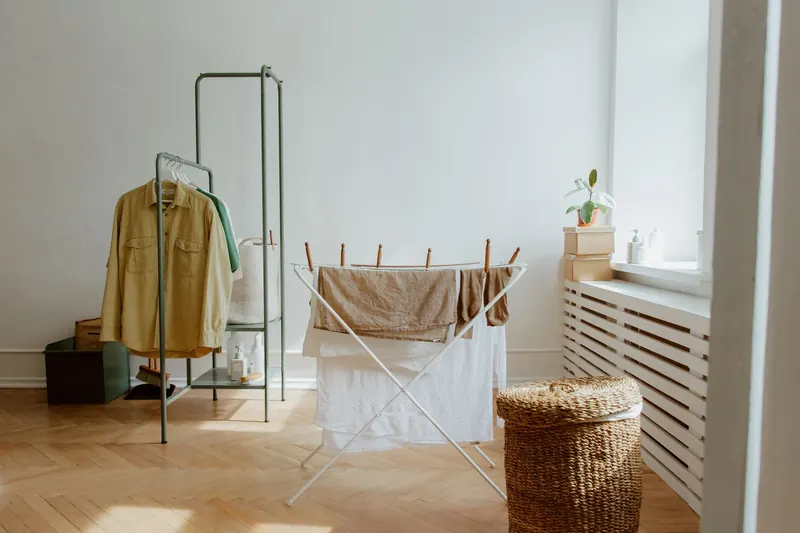
Many dehumidifiers now have a button marked laundry, clothes or a small T-shirt icon. It is one of the most useful modes for British households drying indoors in winter, but the details differ between brands and the manual rarely explains why it works. This explainer covers what laundry mode usually changes, how desiccant and compressor models handle it, and how to set up the room and the airer to make the most of it.
What laundry mode usually changes
In normal mode a dehumidifier extracts until the room reaches the target humidity, then stops. That is fine for condensation, but drying clothes needs fast, sustained extraction and plenty of moving air. Laundry mode changes the settings to suit.
- Extraction: runs continuously, ignoring the usual humidity target, or uses a much lower one.
- Fan: set to high to move more air across the clothes.
- Louvre: opens or swings so the airflow can be aimed at the airer.
- Timer: many models stop after a set time, often several hours.
- Heater: on desiccant models, often runs at the higher heat setting.
Note:Exact behaviour varies by brand and model. Check your manual for what laundry mode does on your machine.
Why it dries clothes faster
Clothes dry by losing water to the air around them. In still, humid air that process slows right down, because the air next to the fabric is already close to saturated. Laundry mode attacks both problems. The high fan keeps fresh air moving over the fabric, and continuous extraction keeps the room air dry, so the clothes keep losing water at a good rate.
On desiccant models the dry air coming out is also warmer, which helps further in a cold room. Compressor models add a little warmth too, but less. Our guide on why clothes smell damp after drying explains why faster drying also means fresher washing.
Setting up the room
The room matters as much as the mode. A dehumidifier working on a small, closed room keeps the air far drier than one trying to treat a whole open plan floor.
- 1
Choose a small room you can close off, such as a box room or utility room.
- 2
Close the door and windows.
- 3
Set up the airer in the middle with space all round.
- 4
Place the dehumidifier about a metre away with its outlet pointing at the clothes.
- 5
Select laundry mode and leave the room closed until the cycle ends.
- 6
Empty the tank, or use continuous drainage for long sessions.
Getting the airer right
Hang items with gaps between them so air can reach both sides. Put thick items such as towels and jeans on the outside rails, where airflow is strongest, and light items in the middle. Turn heavy items halfway through if you can. If you use a heated airer, the warm rails and the dehumidifier work well together: one warms the fabric, the other removes the water. See is a heated airer worth it for the pros and cons.
Do not overload the airer to fit a big wash in one go. Two well spaced sessions can finish sooner than one crowded one.
Compressor or desiccant for laundry?
Both types can have good laundry modes. Compressor models usually extract more in a warm room and draw fewer watts. Desiccant models keep working in a cold room and blow out warmer air, which suits unheated utility rooms and garages. Tank size matters for both, because a laundry session can fill a small tank quickly.
Our guide to the best dehumidifiers for drying clothes compares laundry modes, louvres and tanks, and the best desiccant dehumidifiers covers cold room options. For energy use, see dehumidifier running costs.
| Compressor | Desiccant | |
|---|---|---|
| Best room temperature | Warm, above about 15 °C | Any, including cold rooms |
| Air out | Slightly warmer | Noticeably warmer |
| Typical power | About 150 to 300 W | Often 300 to 650 W |
| Tank fills during laundry | Often | Often |
Meaco and other brands
On Meaco models with a laundry setting, the maker describes it as running for a fixed number of hours and then switching off, and the exact time depends on the model. De'Longhi, EcoAir and other brands use their own names and timings. Because these details change between models and updates, check the manual or the maker's website for your machine. The best smart Wi-Fi dehumidifiers guide notes models whose apps let you start laundry mode remotely.
Frequently asked questions
Is laundry mode the same as continuous mode? Similar, but laundry mode usually also sets the fan to high, opens the louvre and often stops after a set time. Continuous mode just ignores the humidity target.
How long does laundry mode run? It depends on the model. Many run for several hours then stop. Check your manual.
Can I use laundry mode in a bedroom? You can, but the fan is loud on high. It is better to dry clothes in a room you are not sleeping in.
Does laundry mode use more electricity? It runs at full extraction and high fan, so it draws the full rated wattage for longer. The timer helps by stopping it once the clothes should be dry.
What you need
- Check price on AmazonAffiliate link
Meaco Arete Two 20L: 38 dB and H13 HEPA filter
- Check price on AmazonAffiliate link
EcoAir DD1 Classic MK6: 1 °C, auto restart, timer