Guide
What humidity should you set a dehumidifier to?
Published
Note: This page contains affiliate links. If you buy through them we may earn a commission at no extra cost to you. Learn more
In short
For most UK homes, set a dehumidifier to around 50 to 60 % relative humidity. Around 50 to 55 % suits rooms with condensation in winter, and around 55 to 60 % suits general living spaces. Use laundry or continuous mode only while drying clothes. Setting it much below 45 % rarely helps, and it makes the machine run for longer and use more electricity.
Products for this job
Compare all 7 products20 L/day
Meaco Arete Two 20L: intelligent humidity mode
Check price on AmazonAffiliate link30 L/day
Pro Breeze 30L/day: humidity sensor and drain hose
Check price on AmazonAffiliate link21 L/day
Ariston Deos 21S NET: set humidity by app
Check price on AmazonAffiliate link
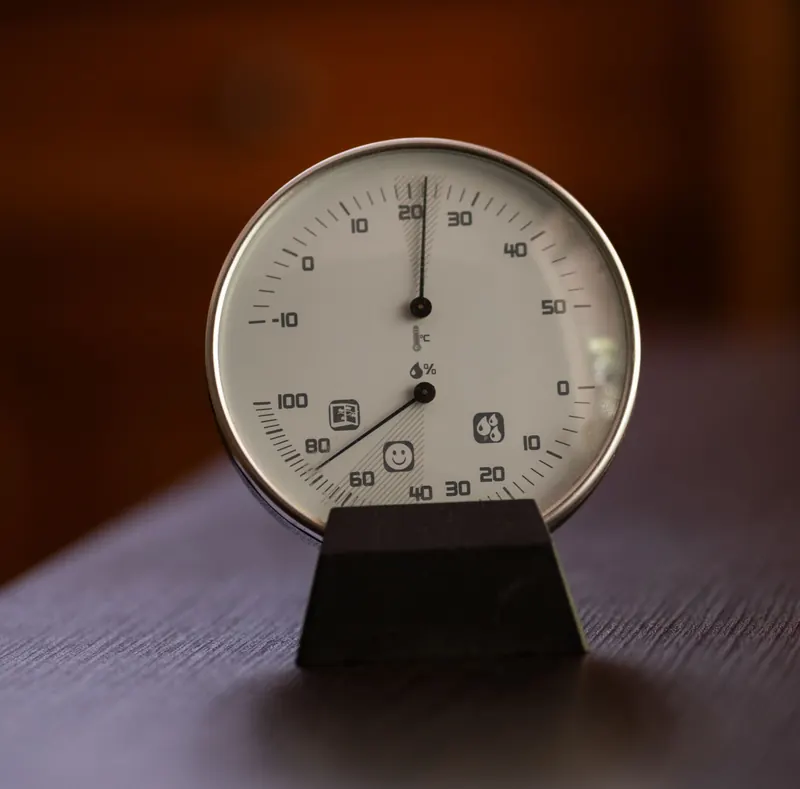
A dehumidifier with a humidistat lets you pick a target humidity, and it switches its compressor or heater off when the room reaches it. Pick too high a figure and condensation carries on. Pick too low and the machine runs almost constantly for little extra benefit. This explainer sets out sensible targets by room and season, what the modes on most machines do, and why the number on the display may not match the far corner of the room.
What the setting actually controls
The setting is a target relative humidity, written as % RH. Relative humidity is how much water vapour the air holds compared with the most it could hold at that temperature. When the machine's sensor reads above the target, it extracts. When it drops below, it stops extracting and usually keeps the fan running slowly to keep sampling the air.
Because relative humidity depends on temperature, the same air reads higher in a cold room than a warm one. That is why condensation is worse on cold walls: the air right next to them is at or near 100 %. Our explainer on dew point and condensation shows how this works, and the dew point calculator lets you try your own figures.
Settings chart by room and season
These are widely used starting points. Adjust them based on what you see. If windows still stream in the morning, lower the target by 5 points. If the room feels very dry and the tank barely fills, raise it.
| Room or use | Winter | Summer |
|---|---|---|
| Living room | 50 to 55 % | 55 to 60 % |
| Bedroom with condensation | 50 % | 55 % |
| Bathroom after showers | Continuous for 1 to 2 hours | Continuous for 1 to 2 hours |
| Drying laundry | Laundry or continuous mode | Laundry or continuous mode |
| Cellar or garage storage | 50 to 60 % | 50 to 60 % |
| Empty or holiday home | 55 to 60 % | 55 to 60 % |
Why lower is not better
Each step down in humidity takes more extraction than the last, because there is less water left in the air to catch. Running a dehumidifier to 40 % in a heated home in winter can keep it running for most of the day, using electricity for little visible gain. Below about 40 % some people also find the air feels uncomfortably dry.
The aim is to keep surfaces below their dew point for as little time as possible, not to make the air as dry as it can be. For most homes that happens somewhere in the 50 to 60 % range. Our dehumidifier running costs article shows how running hours turn into kWh.
Common modes and what they do
Names vary by brand, but most dehumidifiers offer a similar set of modes. Check your manual for the details on your model.
- Auto or smart mode: picks a target for you, often around 50 to 55 %.
- Set humidity: runs until the room reaches your chosen % RH.
- Continuous: ignores the humidistat and extracts until switched off or the tank is full.
- Laundry: runs at full extraction and high fan, often for a set number of hours.
- Night or quiet: lower fan speed and dimmed display, so slower extraction.
- Timer: switches on or off after a set number of hours.
Setting a Meaco or other brand dehumidifier
On most Meaco models you press the humidity button to step through targets, and some have an intelligent or automatic humidity mode. Many other brands work in a similar way. Because the exact buttons differ by model, the manual is the best guide. Apps on Wi-Fi models usually show the same targets plus a log of humidity over time, which helps you see whether a setting is working.
Position matters for any brand. The sensor reads the air around the machine, so a unit beside a radiator reads low and one in a cold corner reads high. Put it in the middle of the room or near the problem area, with space all round. Compare app controls in our guide to the best smart Wi-Fi dehumidifiers.
Check the reading with a separate hygrometer
Built-in sensors can be a few points out, and they only read the air around the machine. A cheap digital hygrometer placed in another part of the room, or on the wall where condensation forms, shows what is happening there. If the dehumidifier says 50 % and the hygrometer by the window says 65 %, move the dehumidifier or lower its target.
Leave both for a day before acting, as readings settle after the machine has been running for a while.
Frequently asked questions
What should I set my dehumidifier to in winter? Around 50 to 55 % suits most rooms with condensation. Lower it a little if windows still stream in the morning.
Is 60 % humidity too high? In a heated room, around 60 % is usually acceptable, but cold surfaces may still get condensation. Many people aim a little lower in winter.
Should I run my dehumidifier on continuous? Use continuous for drying laundry or after a shower. For day to day use, a set target saves electricity because the compressor stops once the room is dry enough.
Why does my dehumidifier say 45 % but my windows are wet? The sensor reads the air near the machine. Next to cold glass the air is much colder, so its relative humidity is far higher. Ventilate and move the unit closer to the problem.
What you need
- Check price on AmazonAffiliate link
Meaco Arete Two 20L: 38 dB and H13 HEPA filter